The problem is fragmentation, not modernity
Modern life can be comfortable and remarkably capable while still feeling incomplete. Housing, work, health, food, care, learning, friendship and purpose are usually purchased or managed through separate systems. The resulting travel, coordination and uncertainty are treated as personal scheduling problems even when they are products of the environment.
Capable Interdependence does not propose a retreat from cities, markets, government or technology. It asks a narrower design question: what would change if the conditions surrounding an entire life were treated as one connected system rather than a collection of unrelated services?
Interdependence with agency
Absolute self-sufficiency is neither realistic nor desirable. People rely on specialized knowledge, public institutions, trade, technology and one another. The relevant question is whether those dependencies are visible, understandable, accountable and capable of failing gracefully.
In this model, capability does not mean every person becoming an expert in everything. It means individuals continue to build practical agency while the community, taken as a whole, can understand and maintain the systems that matter. Shared resources should widen choice. They should never become leverage over housing, work, care, relationships or the right to leave.
What the model proposes
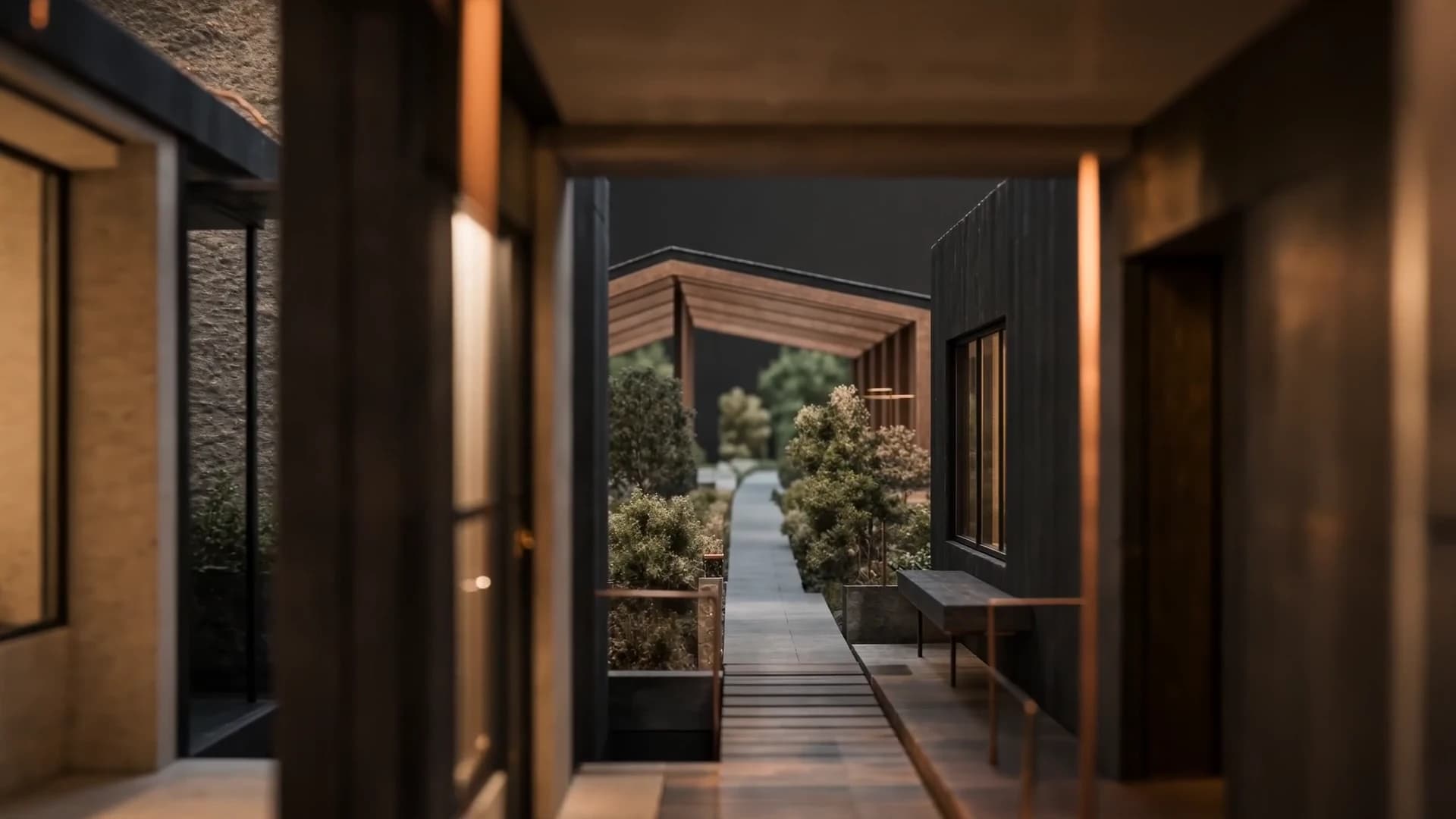
The physical proposal combines secure private residences with useful shared places: kitchens, workrooms, gardens, offices, fitness and care spaces, guest rooms, storage, tools and resilient infrastructure. Proximity is meant to make ordinary cooperation easier without turning daily life into a continuous group exercise.
The institutional proposal is just as important. Housing, employment, health information, discipline and finance should not sit under one person or office. Authority should be divided, time-limited, documented and open to independent review. A credible departure path is a design requirement, not an afterthought.
- Private homes, finances, beliefs, relationships and schedules
- Shared capability where proximity genuinely improves life
- Productive work connected to the wider economy
- Grid-optional essential systems with understandable fallbacks
- Written rights, divided power and independent oversight
- A practical right to criticize, maintain outside relationships and leave
A fuller definition of prosperity
The framework evaluates a good life through six forms of wealth: physical, relational, capability, economic, environmental and purpose. This is a project-specific scorecard, not a universal theory or a promise that a community can manufacture flourishing.
The test is practical. If an institution increases financial wealth while weakening health, relationships, competence, surroundings or meaning, the result is not treated as prosperity. The same principle works in reverse: a warm social ideal that produces dependence or economic insecurity is also incomplete.
Is it cohousing or an intentional community?
Intentional community is the broadest established bridge. The Foundation for Intentional Community defines the category around people who choose to live together or share resources on the basis of common values. Cohousing is more specific: private homes, shared facilities, resident participation and a physical layout designed to support neighbourly connection.12
Capable Interdependence overlaps with both categories, especially in its balance of private and shared space. It is not yet accurate to claim it as an operating example of either. The project remains a proposal and founding process. Its distinctive emphasis is the integration of productive work, practical capability, resilient systems, six forms of wealth and unusually explicit safeguards against concentrated power.
| Model | What it usually describes | Relationship to this project |
|---|---|---|
| Cohousing | Private homes with common facilities and resident participation | A close spatial relative; final ownership and resident-management structures are not settled |
| Intentional community | A broad category organized around shared values or resources | A useful bridge, but the project rejects mandatory ideology and total-life control |
| Capable Interdependence | A proposed modern village joining private life, shared capability, productive work and constrained power | The project’s own design framework; not yet a proven operating model |
What exists now, and what does not
The philosophy, public Founding Framework v0.1, consultation Charter v0.2, Founding Twelve goal and private-plus-shared design direction exist. The legal entities, ownership, housing arrangements, final governance, enterprises, site acquisition and development sequence are still being designed.
No investment return, liquidity, residence, home, property acquisition, approval, service level, move-in date or completed community is promised. The public site begins a discussion. Only future definitive documents, independent advice and completed diligence could create rights or obligations.
Sources and evidence notes
- 1About the Foundation for Intentional Community
Foundation for Intentional Community. Category definition and terminology; retrieved July 18, 2026.
- 2Glossary of Cohousing Terms
Cohousing Association of the United States. Private-home and shared-facility terminology; retrieved July 18, 2026.