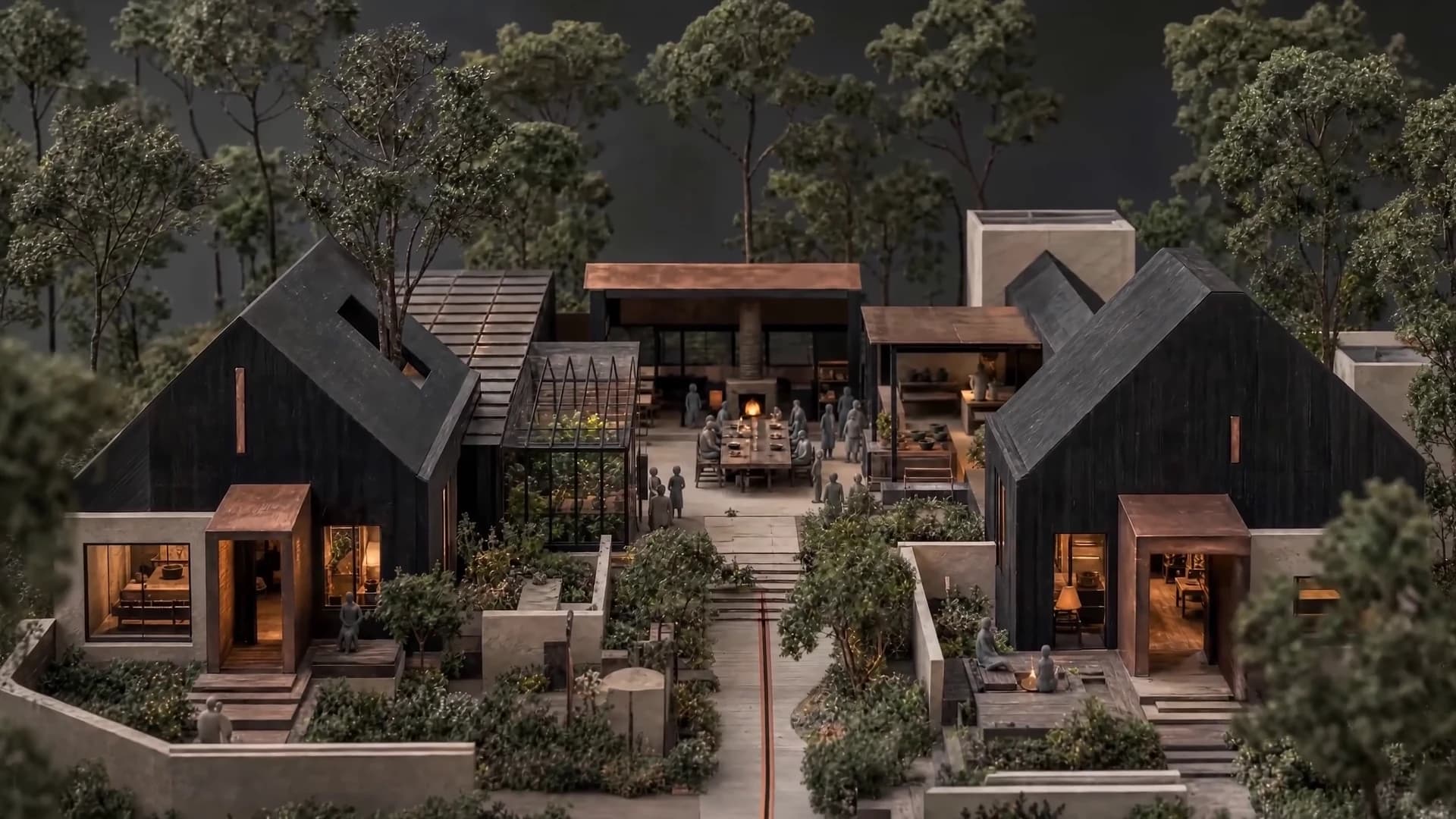
The modern village is an environment, not an aesthetic
The word village often evokes either nostalgia or a real-estate style. Here it means something operational: a human-scale place where enough of daily life is nearby, understandable and connected that people can spend less time coordinating fragments and more time living.
The proposal is contemporary rather than anti-modern. Excellent digital access, professional work, outside healthcare, travel, markets and public infrastructure remain part of life. Local capability provides choice and resilience; it is not a purity test.
Proximity should create invitations, not obligations
Good community design makes useful contact easy: passing a neighbour on the way to work, asking for help in a workshop, joining a shared meal or noticing when someone may need support. It does not require every meal, belief or hour to become communal.
The proposed rhythm is deliberately light: one substantial common table, recurring skill exchange, an open monthly assembly and seasonal work or celebration. These are opportunities to build familiarity. They are not rituals of loyalty.
The village must create value beyond itself
A durable village cannot rely indefinitely on savings, donations, cheap labour or property appreciation. The framework proposes using professional practice, technology, research, design, media, education and other high-value work to finance strong local infrastructure.
Food, land stewardship, workshops, fabrication and hospitality add resilience and texture. They should not be romanticized as the sole economic engine for an expensive, professionally operated place. Members remain free to work for outside employers or run independent businesses.
Grid-optional, not cut off
Grid-optional means using wider systems when they work while preserving essential functions when they do not. Heat, electricity, water, waste, communications, food storage, transport, care and emergency response should have understandable redundancy and manual fallbacks.
This is ordinary responsible infrastructure design, not collapse theatre. Connection to neighbours, public services, regional producers and external expertise is part of resilience. Isolation would make the system less capable, not more.
How this differs from a subdivision, resort or commune
A subdivision can provide private property and amenities without creating shared responsibility or local competence. A resort can provide comfort without resident governance or productive life. A commune may integrate work and community but can imply shared finances, property or ideology.
This proposal combines private life with selected shared capability, meaningful work and explicit constitutional limits. Whether the final result qualifies as cohousing or another legal category depends on ownership, resident participation and governance decisions that remain open.
The standard is ordinary life
The proposal should ultimately be judged by ordinary outcomes: whether people have usable privacy and dependable connection, whether practical skills increase, whether work and compensation are fair, whether infrastructure can be understood, and whether people can leave without punishment.
The first village, if built, would be a demonstration rather than proof of a universal solution. Its failures, departures, governance disputes and changes would matter as much as its architecture.
Sources and evidence notes
- 1Glossary of Cohousing Terms
Cohousing Association of the United States. Definitions of private residences, common facilities and resident management; retrieved July 18, 2026.